Methoni: Venetian Eye of the Morea
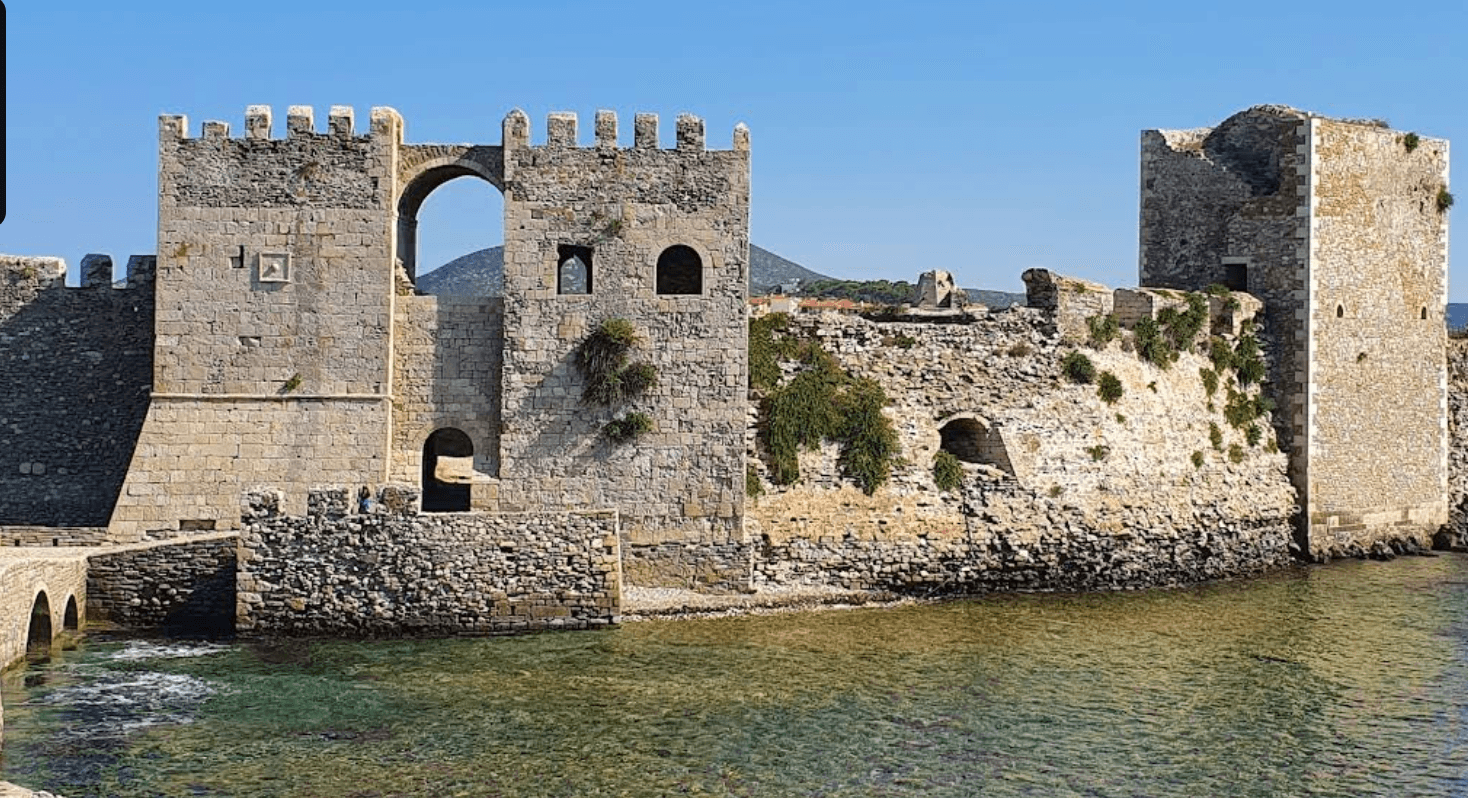
Known in Venetian sources as Modon, Methoni anchors the southwest tip of the Peloponnese. A walled port-town fused to a headland, it controlled the sea lane rounding the Morea and offered safe water, provisions, and repair. What survives today is a layered fortification: medieval curtain walls, Venetian bastions, Ottoman repairs, and a small offshore keep (Bourtzi) watching the harbor mouth. Within the enceinte lie the traces of a compact town—cisterns, chapels later reused as mosques, baths—signs of a community built around the needs of shipping and garrison life rather than courtly display.
Venetian Eye of the Morea
Venetian writers paired Modon and Coron as the “two eyes” of the Republic in the Morea. Take the phrase with a pinch of salt—it is rhetoric as much as strategy—but it captures the point: Methoni’s value was surveillance and service. From here convoys were staged, pirates deterred, and customs collected. The fort’s plan reflects that workmanlike brief: robust landward defenses across the isthmus, artillery platforms covering approaches, and logistical features (stores, water, slipways) to keep ships moving. When regimes changed, the job description didn’t; new rulers inherited the same geography and the same headaches.
Gate to the Levant
For pilgrims, merchants, and soldiers sailing east, Methoni was a threshold. Incoming traffic from the Adriatic could replenish and sort itself before crossing to Crete, Cyprus, or the Syrian coast. Outbound traffic from the Aegean funneled west through the same notch. That gate function explains the site’s repeated refortification in the fifteenth to eighteenth centuries: whoever held Modon could tax, police, or harass the flow. It also explains the town’s mixed material culture—Latin and Greek inscriptions, Ottoman civic works—layered in the same stones.
Modon’s Sea Bastion
Methoni’s seaward identity rests on two elements: the harbor-facing works and the Bourtzi islet. Together they form a focused bastion aimed at the channel. The effect is not grandeur but control: narrow the entrance, triangulate fire, and keep watch. Read the fabric that way and Methoni is less a romantic ruin than a precision tool—part of a network that made long-distance Mediterranean sailing feasible, profitable, and, when needed, coercive.