Palamidi Fortress Crowning Bastion of Nafplio
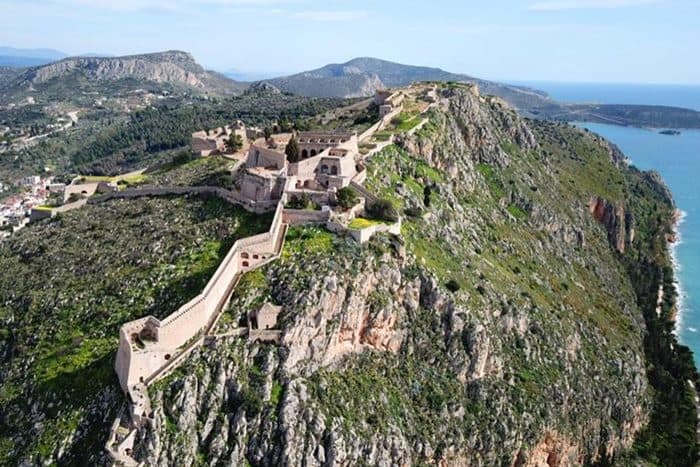
Built in the last Venetian push before 1715, Palamidi crowns the ridge above Nafplio as an eight-bastion crownwork keyed to artillery, not spectacle. Read its walls and you can still see the project phases: crisp Venetian ashlar on exposed angles, drafted corners and well-regulated courses on the faces most likely to take fire, then later Ottoman stitches—different mortar color, brick relieving arches, patched embrasures—where damage and use demanded repair. Inside, magazines, cisterns, and traverses sit exactly where a working garrison needed them. This is a fort engineered to command the bay and the roads—not a palace with cannon.
Crowning Bastion of Nafplio
Palamidi’s job was simple: put guns higher and farther than the older Akronafplia could. The bastions interlock, their flanks covering each other’s ditches, their salients angled to deny dead ground. On site you can track the logic in stone: wide ramps laid for moving pieces, barbettes where open fire was preferable, casemated positions where wind and angle demanded cover. Venetian tool marks and occasional inscription plaques fix the initial build in the early 1710s; later infills and re-mortarings betray the garrison’s long, practical conversation with salt air and siege.
Eighteenth-Century Venetian Citadel
The first Venetian occupation of the Morea in the late 1680s exposed a weakness: fine walls at sea level, but no commanding platform. Between 1711 and 1714 Venice corrected that with Palamidi. The geometry was right; the calendar was not. In 1715 an Ottoman army and fleet overran the peninsula. The new rulers did what good soldiers do: they kept the fort. Ottoman maintenance left a readable layer—different mortars, re-cut embrasures to suit their ordnance, repaired stair runs, and practical reuse of spaces as prayer halls or stores. The citadel’s authorship changed; its function didn’t.
The Heights Above Nafplio
When the Ottomans returned in 1715, they found a fortress that finally solved Nafplio’s vertical problem. Holding Palamidi meant superior observation and fire control over the Argolic Gulf and the Saronic approaches—exactly the hinge a state needs to police movement between the Aegean and the western routes. From there, batteries could overmatch ships at anchor, reassure supply convoys, and discourage nuisance raids. The masonry tells the whole arc: Venetian ambition set in squared stone, Ottoman pragmatism stitched through the joints—one height, two regimes, the same strategic conclusion.