Nafplio: Key to the Argolic Gulf
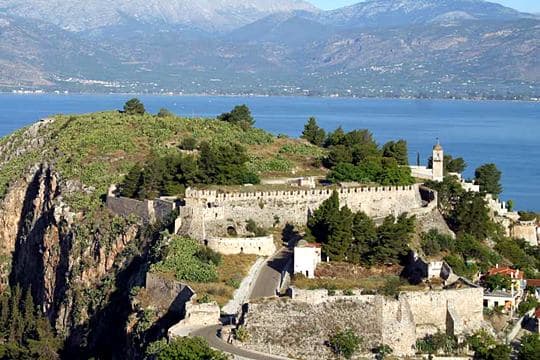
Nafplio
Known in Venetian usage as Nauplion, Nafplio sits on a tight harbor under two heights: the old Akronafplia and, above it, Palamidi. The site reads as a sequence of re-armaments: medieval walls, early‐modern gun platforms, and in the early 1700s a last, ambitious Venetian push to dominate the bay from above. The town behind the quays served fleets more than courts—storehouses, water, workshops—yet its skyline announced power. In 1715 the Ottomans took the place in a fast campaign; they kept the working harbor but rationalized garrison life, mosques, and administration to their system. The masonry changed little; the use changed decisively.
Harbor Capital of Argolis
As the de facto port-capital of Argolis, Nafplio provisioned ships for the Argolic Gulf, the Saronic approaches, and runs toward the southern Aegean. Under Venice, state convoys and private carriers alike found predictable service: pilotage, dues, repairs. The Ottomans kept that logic—because the geography demands it—but redirected the flows to Ottoman fiscal and military calendars. Venetian metrics (convoy windows, arsenal routines) gave way to Ottoman ones (provincial supply, troop rotation), yet the harbor’s daily rhythm—haul, caulk, water, depart—barely paused. Continuity of function, change of regime.
Key to the Argolic Gulf
The key was high ground. Between 1711 and 1714 the Venetians built Palamidi—a multi-bastioned crown that finally put commanding artillery where earlier walls could not. It was the right idea and the right height, but the wrong timing: in 1715 an Ottoman field army and fleet overwhelmed the Morea; Nafplio fell within weeks. Afterward the fortress system was not reinvented so much as repurposed. Ottoman Nafplio kept Palamidi as the capstone, repaired curtains and batteries, and fitted the complex to Ottoman garrison practice. The early-eighteenth-century “shift” is visible less in stone than in signage and staffing.
Port and Citadel of Nauplion
Think of Nafplio as paired infrastructure: a port that services traffic and a citadel that guarantees it. Venice invested to secure convoy movement and customs; the Ottomans held it to lock down regional supply and policing. Both read the same chart, both drew the same conclusions. If you want the Argolic Gulf, you need the quay, the magazines—and a fortress on the ridge that sees first and shoots furthest. Palamidi delivered that geometry; 1715 decided whose flag worked beneath it.